Cloud Economics
Cloud Margin & Cost Optimization
Reduce cloud spend and keep your bill from outgrowing the business as you scale, without weakening reliability, security, or performance.
Discuss this serviceHow we engage
A focused assessment of current spend, future cost, and the architecture behind both.
Cloud margin assessment
A current and forward-looking review of spend, architecture, unit economics, and the cost drivers most likely to grow with the system. You leave knowing what is efficient, where money is going to waste, and what your team should consider next.

Business outcomes
What changes for the business.
The work is grounded in technical detail, but its value is measured by what your organization can do with greater confidence.
Cut spend now, and keep it down as you grow
Capture worthwhile savings in the current environment while addressing architectural cost drivers that could grow disproportionately with usage.
Make infrastructure spend more predictable
Give finance, engineering, and leadership a shared understanding of what drives spend, how costs are likely to change, and which assumptions create forecasting risk.
Protect the operating bar
Improve cost efficiency without weakening the reliability, security, latency, or performance customers depend on.
Return engineering capacity to the product
Over-complicated infrastructure bills twice: once on the invoice, and again in the hours engineers spend keeping it running. Simplifying it recovers both.
How the engagement works
From technical context to a decision the business can act on.
01
Establish the current baseline
We review usage, cost allocation, workload shape, AWS account structure, operational patterns, and the architecture decisions that drive recurring spend.
02
Model the future cost curve
We connect growth assumptions to the architecture so leadership can see which costs should scale predictably and which may grow faster than usage or revenue.
03
Review options and align on priorities
We present credible options, from immediate optimizations to deeper architecture changes, and discuss their financial value, effort, operational impact, and reliability risk with leadership and engineering. Your team determines which changes to pursue and in what order.
04
Translate priorities into engineering execution
We translate the options you align on into work your engineering team can execute with confidence, working alongside them on approach and sequencing, and defining the measures the business will use to track savings.
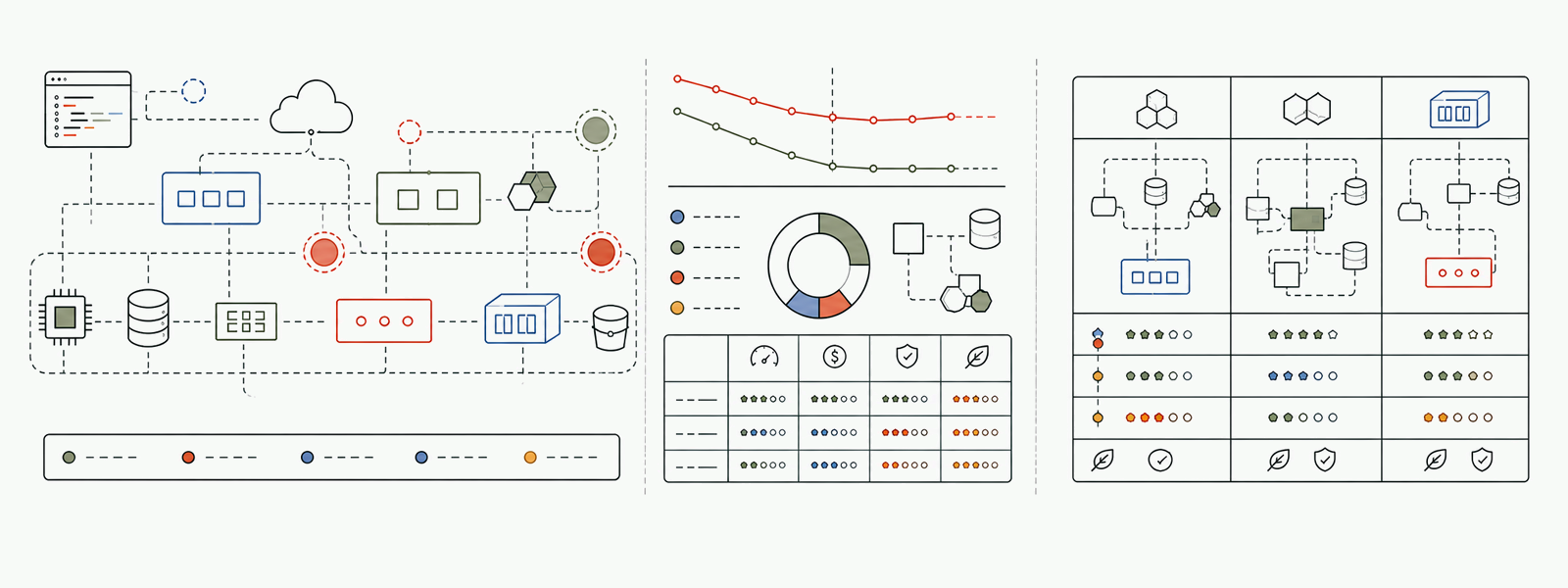
What you receive
Useful outputs, not a consulting black box.
The result is a shared financial and technical decision model for leadership, finance, and engineering.
Featured output
A current and projected cost model
See where infrastructure spend comes from today, how it is expected to change as the system grows, and where uncertainty could lead to an unexpected bill.
Architecture options with explicit tradeoffs
Understand the design choices driving spend and the credible alternatives, including financial value, implementation cost, operational impact, and effect on the operating bar.
A unit-economics model the business can use
Connect infrastructure cost to the measure that matters for the company, such as product, customer, tenant, workload, or transaction.
A prioritized decision and implementation roadmap
Start with the savings available now, then rank the bigger changes by return against effort, so leadership can fund the work in the order that pays.
An executive readout
Finance, product, and engineering leadership leave with the same narrative about where spend is going, why it matters, and which decisions need funding.
Why choose 2birds
Principal-level judgment grounded in operating reality.
- 01We have operated AWS services where infrastructure margin was a first-order business concern, not an abstract FinOps metric.
- 02We know how cost, reliability, latency, security, and operational load interact because we made those tradeoffs as principal engineers on AWS services, not as outside reviewers.
- 03We look for architecture-level opportunities that tools and billing reviews usually miss: data movement, retention, workload shape, database choices, regional design, and reliability-driven overprovisioning.
- 04We look for opportunities to simplify operations as well as reduce spend because recurring operational load is itself a cost to the business.
- 05We help leadership and engineering align on a plan that protects the operating bar, reduces spend, and makes the savings measurable.
Technical scope
Depth follows the decision.
The assessment follows the engineering behind the bill, from workload behavior and data movement to the financial model leadership uses to make decisions.
- Architecture and data-transfer cost analysis
- Storage, retention, and observability spend review
- Compute and workload-shape economics
- Capacity, autoscaling, and idle-resource economics
- Managed-service versus self-managed tradeoffs
- Multi-region and reliability-driven cost tradeoffs
Start with the decision in front of you