Production Engineering
Architecture, Reliability & Production Readiness
Strengthen architecture before it becomes a production risk, and give teams the confidence to launch, grow, and move faster.
Discuss this serviceWays to engage
Choose the kind of support your team needs.
Comprehensive Architecture & Production Readiness Assessment
A full-system view across reliability, scalability, security, applicable compliance requirements, cost, and operational load, often around a launch, incident, growth event, or enterprise commitment. You leave knowing what is production-ready, where meaningful risk remains, and what your team should address before it matters.
Ongoing design and launch review support
Recurring principal-level review of consequential designs before teams build them, with fast feedback and structured readiness reviews before important releases. You leave each review knowing whether the design holds up, where the risk is, and what to change before your team builds it.
Business outcomes
What changes for the business.
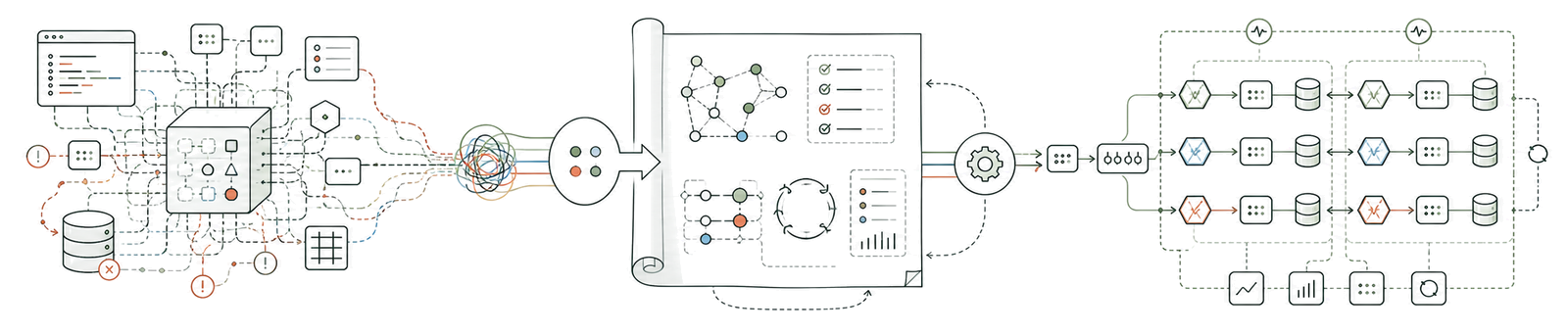
We work in the architecture so the business sees the result somewhere else — launches that hold, incidents that don't spread, and growth the system can absorb.
Improve decisions before implementation
Understand how the system can fail and what each failure would cost, and catch unnecessary complexity and unclear ownership — before any infrastructure is built.
Turn production risk into a decision
Know the system's limits, what happens when they're hit, and what it costs — so each risk gets fixed, accepted, or watched on purpose rather than discovered in an outage.
Build confidence for launches and growth
Understand how the system is likely to behave under increased demand, dependency failures, deployments, and recovery events.
Recover engineering capacity
Reduce recurring operational work and fragile system behavior that pull engineers away from improving the product.
How the engagement works
From technical context to a decision the business can act on.
01
Understand the current architecture and desired outcomes
We start with the pressures you're feeling today and the outcomes you're aiming for, then set the review mode and decision criteria to match — a comprehensive assessment across the full service boundary, or recurring design checkpoints and launch reviews for ongoing support.
02
Review the design or production reality
We trace how the system actually behaves in production — how work flows, where it depends on things outside its control, how it's deployed and observed, and what's assumed about recovery when something fails.
03
Challenge failure and growth assumptions
We identify unclear scaling limits, ambiguous ownership, and recovery assumptions that have not been tested, then connect them to customer and business impact.
04
Evaluate options and launch readiness
We compare targeted mitigations and deeper architecture changes, and apply the 2birds launch-readiness framework before important releases.
05
Hand over a decision, ready to execute
We translate the options you align on into work your engineering team can execute with confidence — ranked by impact, urgency, effort, and dependencies, sequenced alongside your team, and tied to the measures the business will use to track the improvements.
What you receive
Useful outputs, not a consulting black box.
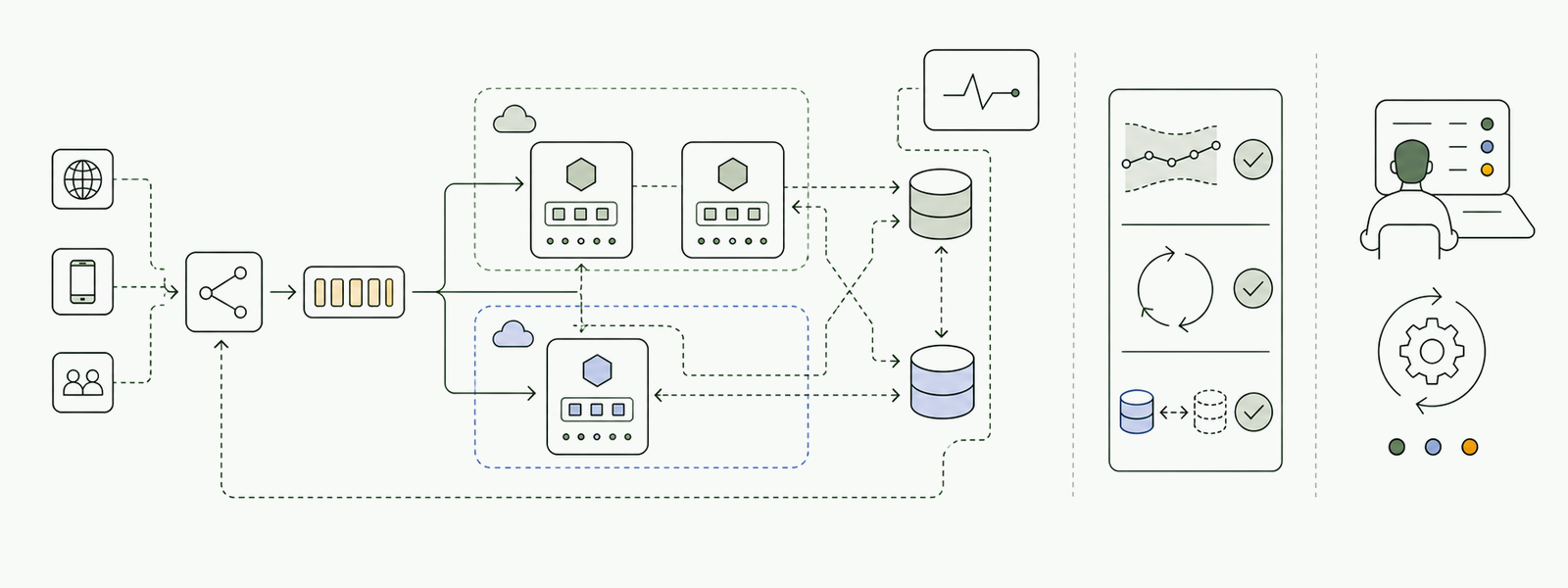
Ongoing support emphasizes timely design and launch decisions. Comprehensive assessments provide a full-system risk picture and resilience plan.
Featured output
Principal-level design review feedback
Receive clear feedback on consequential proposals, including important tradeoffs, unresolved assumptions, credible alternatives, and recommended next decisions.
A structured launch-readiness review
Identify blockers, accepted risks, capacity and recovery assumptions, operational ownership, and the work that must be completed or monitored.
A comprehensive production-readiness assessment
Get a full-system view of failure modes, recovery gaps, scalability limits, security and compliance concerns, cost tradeoffs, and operational load.
A prioritized action plan
Leave with near-term mitigations, deeper architecture options, sequencing, ownership, dependencies, and visible measures of progress.
An executive readout
Engineering and business leadership get the same view of material risks, credible options, and decisions that require funding or acceptance.
Why choose 2birds
Principal-level judgment grounded in operating reality.
- 01We have designed, built, operated, and scaled AWS systems where failures, bottlenecks, and recovery assumptions had real customer and business consequences.
- 02At AWS, challenging consequential designs before they were built was a core responsibility of principal engineers. We bring that same discipline to clients — fast feedback before designs harden, held to a consistent readiness bar before important launches.
- 03We review architecture through a production lens: dependencies, deployment safety, data stores, queues, observability, recovery paths, capacity limits, and ownership boundaries.
- 04We look for bounded behavior, testable scaling limits, and clear data ownership so architecture remains understandable under real production pressure.
- 05We separate risks that merely look uncomfortable from risks that deserve funding because they threaten launches, engineering velocity, enterprise commitments, or customer trust.
- 06We identify credible options without assuming every system needs a rewrite or more microservices.
Technical scope
Depth follows the decision.
The review connects architecture details to production behavior and business consequences, with depth determined by the decision or service boundary in scope.
- Independent architecture and design review
- Comprehensive production-readiness assessment
- 2birds launch-readiness framework
- Failure-mode, recovery, and disaster-recovery analysis
- Scalability, capacity, and load-testing strategy
- Operational-load, observability, and incident review
Start with the decision in front of you